Assignment 1 | Term 2: CTR
Category
– Visit Characterization
Click-through-rate, or CTR, is an important metric for
search engine marketing and digital advertising. CTR is a metric defined as the
“number of click-throughs for a specific link divided by the number of times
that link was viewed.” (Reed College of Media, 2018) The metric allows for an
apples-to-apples comparison on the performance of an advertisement or keyword
within a search engine marketing campaign. For example, you can compare the CTR
of one keyword advertised across multiple search engines to determine which
provider performs the best.
There
are many practical business applications for making CTR a primary key
performance indicator of a digital advertising campaign. If your intended goal,
for example, was to increase applications for vehicle loan refinances, and you
wanted to run a display and SEM campaign, at what point in the purchasing
decision would you have the best response for your ads? This is a practical
problem in the financial services industry, where one might be tempted to run
advertising late in the purchasing decision cycle, or early, to raise attention
to the product. Also, how would one benchmark those results within the industry
to make sure they either performing at, or above, where other similar
businesses are.
In
looking at the auto refinance example, we can find a benchmark with some
industry research. Alexander Clark of Smart Insights notes that the financial
services industry sees an average CTR of 2.65% on SEM and 0.33% CTR on display.
(Clark, 2016) The CTR for search is the second highest ratio compared across
multiple industries.
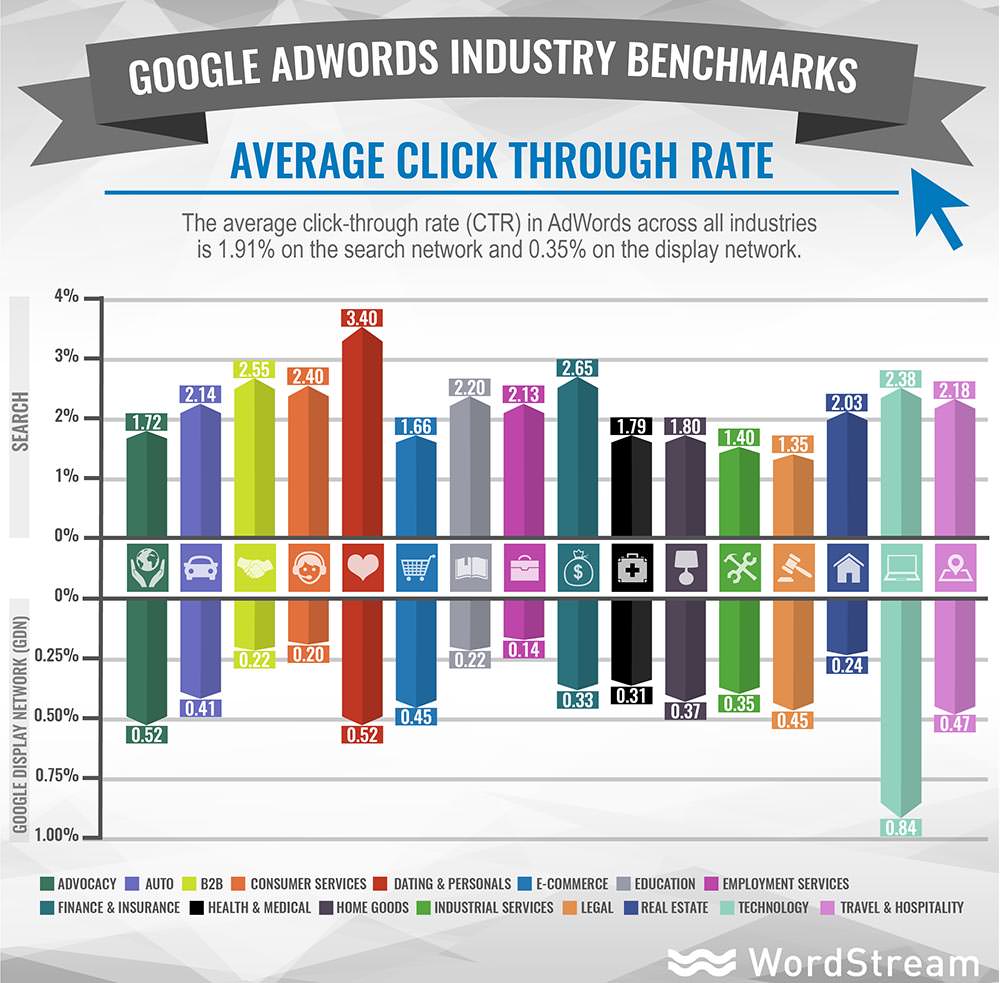
(Clark, 2016)
The
distinction is important, as a benchmark CTR must be applicable for the
industry and not generic. Giving a brief example, the vendor I used for our SEM
campaign at a previous employer constantly touted that our CTR of around 3% was
far performing his other clients. While this number was impressive compared to
his other clients, which were not financial institutions, it appears to be less
impressive when compared to the industry average.
In
revisiting the Auto Refinance Campaign example, CTR can be used at an early
buying stage to prospect potential customers who may not be considering, or
aware of, the option to refinance their current car loan. This would include
buying keywords that target people who are searching for the login address for
their current car loan holders, which are typically car manufacturer captive
financing – Ford Motor Credit, Hyundai Capital, etc. The messaging would include
copy such as “you can refinance your car loan with no fees!” or “reduce your
monthly payment on your current car loan.”
At
the opposite end of the campaign, the targeting would include search terms for the
specific intended action. In this case, people searching for “best car loan refinance
rates” or something similar. These keywords are highly competitive and costly, but
they could yield a customer who is more likely to complete the loan application.
At my previous financial institution, we completed a campaign that measured both
of these results with the primary KPI being CTR. We found that marketing to those
at the end of the purchasing decision cycle yielded a better CTR and conversions
for the campaign.
While
there are many important metrics within digital marketing, click-through-rate ranks
as one of the highest. It provides for practical, and easy to understand analysis
when comparing the success of campaigns.
References
Reed College of Media. (2018). Week 1
Lesson: Intro to Web Analytics and the Basics of Web
Analytics. Retrieved January 16, 2018.
Clark, A. (May 18, 2016). The
average click through rate (CTR) for 20 key Industries. Smart
Insights. Retrieved
from https://www.smartinsights.com/paid-search-marketing-ppc/average-click-rate-ctr-20-key-industries-chartoftheday/
I love this infographic you included that visualizes the CTR for different industries. As someone who works in marketing for insurance, I find it interesting to see where “Finance & Insurance” rank compared to other industries!
ReplyDeleteAs I start to work more with Google Analytics, I’ll be sure to pay close attention to where our visitors are coming from. Are they linked through our mass emails? Through our actual emails? From our social media sites?